
Hello friends! I find myself completely restless at 2:30 AM for yet another night with my mind endlessly racing thinking about a million things that I want to write. Sounds like a perfect combination for starting yet another blog post.
I’ve been watching many different TED Talks clips lately on the subject of mental illness, and more specifically depression, that my father sent me when I told him about my decision to declare my advocacy for mental health awareness. After the first 25 minute clip that he asked me to watch by Andrew Solomon, the related videos seemingly grew more and more attractive, and I found myself quickly following a path of no return into the “related videos” section, eventually striking gold in a mine of inspiration for my second post.
There is a face often identified with depression, as though people feel that they can pick a depressed person out from a crowd based entirely on their beliefs, interests, hobbies or appearance. Star students can’t be depressed. Professional athletes can’t be depressed. If you have a high paying job, happy family, and tons of friends, you can’t possibly be depressed. “If half of the world’s population has it worse off than you, why do you think you have the right to be unhappy with your life? Consider yourself lucky.”
Two of the darkest periods in my life were grades 5-6 and grades 10-11. I experienced bullying heavily in early middle school, to the point where I was unbelievably temperamental and in a full-on defensive mode for a vast majority of my days. This attitude didn’t only last at school, however, but followed me home where I would argue with my mom about anything and everything while she was trying to raise me largely on her own while my dad was completing his PhD in Alberta. This part of my life haunts me every single day, and contains probably the biggest regrets of my life in how I treated others; both friends and family. I want to use this post to apologize for my past actions against people that I went to school with that I massively mistreated without knowing anything about them personally, as well as the most important woman in my life in my mother. I can’t imagine how difficult it must be to raise three children at home while juggling a full time job with trying to remain in a long-distance relationship with my father. Although I cannot always control my behavior and I had only just begun experiencing depression and had been learning how to cope with it, it is never a viable excuse to mistreat people.
I was very overweight in my middle school years, and this was probably the biggest target of the bullying I experienced. One of the clearest memories I hold from these years is when one of the most popular, prettiest, well-liked girls in the school made fun of me for my weight, and I figured “if even she thinks I’m not worth anyone’s time because of my appearance, am I worth anyone’s time?”.
That night, I sat at the end of my bed as thoughts dark as night crept further and further into my brain, playing those words back in my head like a broken record. “If I’m not worth your time, I’m probably not worth anyone’s time.” At this point, I began for the first time in my life and one of the few times, thinking about whether I should take my own life. At the age of only 11, I was already thinking that maybe the next 60-70 years of my life wouldn’t be any better and weren’t worth enduring. I wasn’t someone who had been struggling with my grades, or having girl troubles, and I wasn’t fired from my job. I was a little kid in early middle school experiencing the first of his mental illness struggles.
These memories of middle school never really left me, and so I tried to run away from my own problems and start again in a new school in Winnipeg when my grade 10 year came around. By this time, I was turning into a fairly high-level volleyball player, and decided that switching schools was my best option to pursue volleyball further as well as start off on a new slate and make new friends. I told myself that I would try my best to treat people as well as I knew how to and that this would somehow make me happier, but it didn’t. I experienced similar bullying in the new school day in and day out, and can recall numerous times where I refused to participate in school events due to anxiety attacks and deep depression, but my mom pushed me through them. I recall one time where this happened at German night, which was just a small production put on for parents by everyone who was enrolled in the German classes at the school. My mom asked me to push through my feelings and not let the rest of the class down, and for one of many times, I faked a smile and acted like everything was okay when it really wasn’t. I never told anyone about my depression at this school, and continued on getting bullied and feeling as though if I revealed what had been happening to me that I would simply be passing the burden from myself unto others. I didn’t think that was fair, so I wallowed in my own emotional problems for years and years.
This idea that somehow depression is simply lack of gratitude for the things that you have been given or that people decide to behave this way is one of the most infuriating things to experience first-hand. There is so little understanding surrounding mental health and the impact that it has on the individual’s mind, and although I can understand why things are this way, I don’t understand people’s reluctance to begin adopting evolving ideals surrounding mental health.
Why would I ever want to feel this way? Why would I go ten years and only ever tell seven people how I feel if the reason I decided to come out with everything was only for attention? I could tell people everywhere I go that I suffer from mental illness if I did it for attention, but yet I still feel incredibly nervous talking about my problems out in public because I’ve had it blow up in my face numerous times. People have cut off relationships with me because they couldn’t handle my altering moods, reluctance to go out, and need for personal space.
The sad truth surrounding mental illness is that no one is willing to talk about it until it’s too late; until your friend that you had suspected of being depressed took his own life.
Until you hear the talk around the community of the little girl down the street who took her own life.
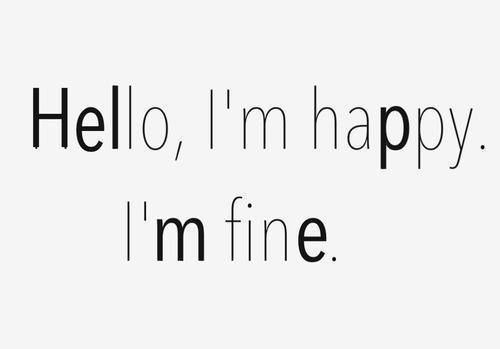
Until the one closest to you is gone without leaving a word about how they felt. Honesty needs to be the expected answer when you ask how someone is doing, not “I’m fine”.
“The scariest part is that after a while you become numb to it and what you fear the most isn’t the suffering inside of you, but the stigma inside of others. It’s the shame, it’s the embarrassment, it’s the disapproving look on a friend’s face. If you think that the stigma isn’t real, ask yourself this: “Would you rather have your Facebook status as ‘I can’t get out of bed because I hurt my back’, or ‘I can’t get out of bed because I’m depressed'”?
– Kevin Breel
So let’s talk,
Garrett Suderman
sudermangblog@gmail.com
 garrett suderman - words and things